
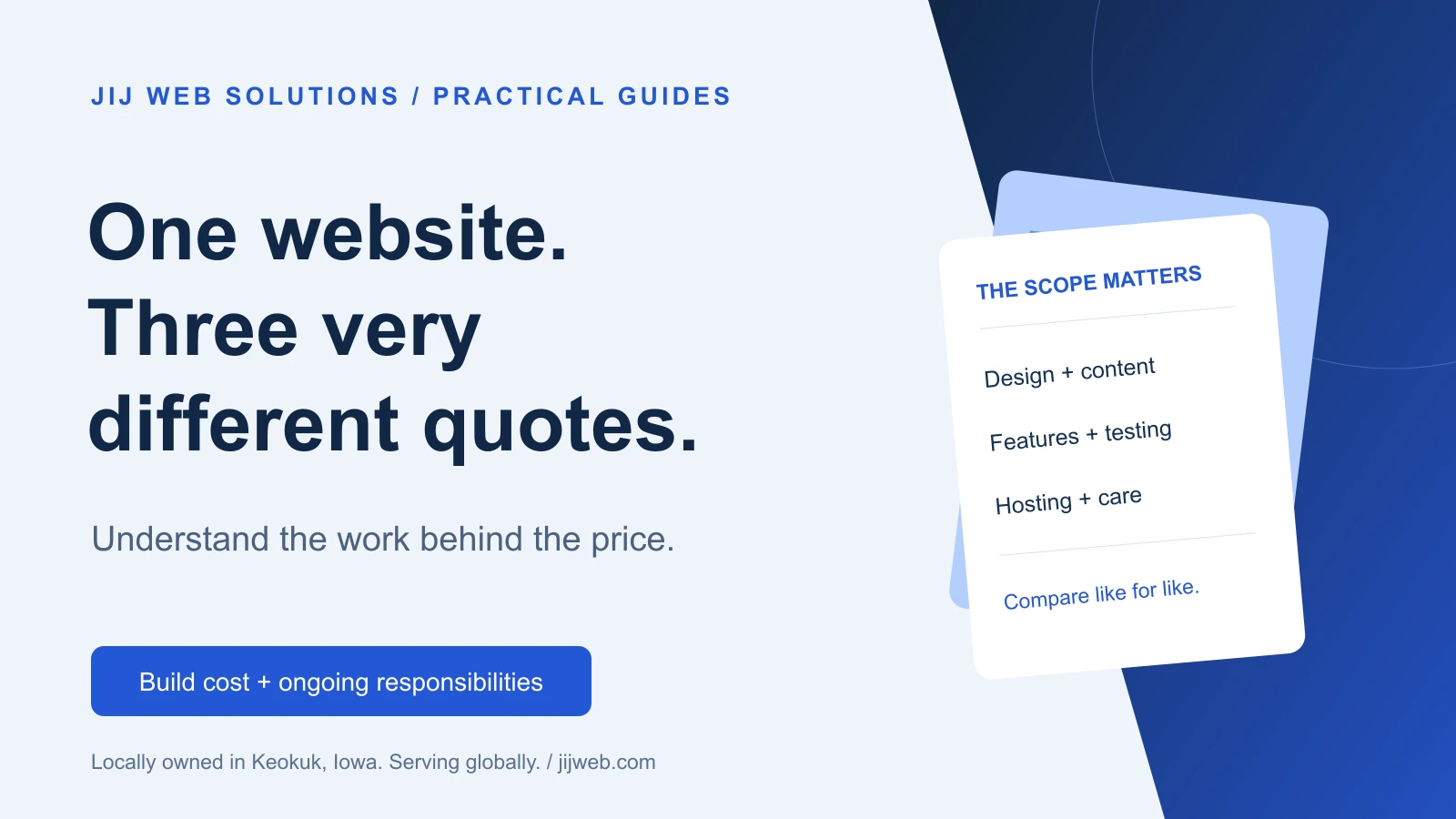
You requested three website quotes. One is $500. Another is $3,000. The third is $10,000. How can they all be quoting the same website?
Often, they are not.
One proposal may cover adapting a theme using content you supply. Another may include original layouts, copywriting, product setup or connections to your business software. The headline price tells you very little until you know what is being delivered.
The useful question is not simply “What does a website cost?” It is “What will this website need to do, what is included, and what will it cost to keep it working?” This guide helps you answer all three.
The short answer: price follows scope
A single landing page, a five-page business website and an online store are different projects. An established CMS can save the work of building a content-management system from scratch, but design, configuration, content entry, testing and handoff still take work.
Here are JIJ Web Solutions’ published one-time planning ranges, reviewed October 23, 2026. These are JIJ’s starting ranges for the described scopes, not national averages, binding offers or promises that every project fits a package.
| Project | JIJ planning range, USD | Starting scope |
|---|---|---|
| Landing page | $600–$1,200 | One page, up to eight sections, supplied content and a basic inquiry form |
| Business CMS website | $1,200–$2,500 | Up to five content pages, an established theme or supplied design, CMS and a basic form |
| Original-layout CMS website | $2,500–$4,500 | Up to five content pages with original layouts, CMS and a basic form |
| Small online store | $3,000–$6,000 | Up to five marketing pages, up to 25 simple products, one supported payment gateway and basic shipping setup |
These website packages include responsive layouts, basic launch SEO, browser and form checks, two consolidated design revision rounds, and handoff. Copywriting, new branding, specialized features, hosting, licenses and applicable taxes are additional unless your proposal includes them. The written quote establishes the final scope and price.
Review current JIJ service pricing. Prices and package details may change after this article is published.
What are you actually paying for?
1. Planning and a clear path for visitors
A website needs a purpose before it needs a color palette. A contractor may need qualified estimate requests. A restaurant may need menus, location details and an ordering link. A store needs a reliable buying process.
Planning defines the pages, the information visitors need and the action they should take. A short, well-organized site can serve a business better than a large site with no clear next step.
2. Design and implementation
Adapting an established theme generally starts with more of the layout already decided. Original layouts involve more design decisions and implementation work. Either approach can be professional when it suits the business and is implemented carefully.
Ask what “custom” means in a proposal. Does it mean a custom color scheme on an existing theme, original page layouts, or a new application with its own business logic? Those are different deliverables.
3. Content and migration
“Five pages” does not tell you who writes them. A quote may assume you will supply approved copy, usable photographs and a logo. Another may include interviews, writing, image selection and editing.
An existing site can add migration work: moving articles, preserving important URLs, setting redirects and checking forms. Domain and email changes also require a plan so a website move does not accidentally interrupt business email.
4. Features and connections
A contact form is different from a booking system that checks staff availability, takes a deposit and sends reminders. A product display is different from a store with taxes, shipping rules, variants and checkout.
For each feature, describe what should happen before and after someone uses it. Which system stores the information? Who receives the notification? What happens if a payment fails? Those answers help turn a vague feature request into a scope that can be priced.
5. Testing, launch and handoff
The project should define how forms, mobile layouts, important browsers and any payment workflow will be checked. Agree on who supplies final approvals and what needs to be ready for launch.
Handoff matters, too. Your team should know how to make the agreed updates, where account access lives and how to get help. Training, documentation and post-launch support should be described rather than assumed.
The website build is only one part of the budget
Separate one-time work from recurring costs. That makes both the first-year budget and later renewals easier to understand.
| Cost | What to clarify before approving |
|---|---|
| Website build | Pages, design approach, features, content responsibilities, revision rounds and launch work |
| Hosting | Billing term, resources, supported software and renewal price |
| Domain | Registration, renewal, ownership and who manages DNS |
| Software | Theme, plugin or platform licenses; renewal terms; which account owns them |
| Website care | Updates, backups, checks, editing allowance and exclusions |
| Operating services | Payment processing, email delivery, booking tools or other third-party usage fees |
Hosting provides the environment for the site. It does not automatically include writing new pages, applying every software update or fixing a compromised application. A care plan is a separate service unless the agreement says otherwise.
A concrete first-year example
Suppose your agreed website build is $1,800 and the site is suitable for JIJ Starter hosting at $120 per year. Those two items total $1,920 for the first year, before domains, licenses, taxes or any other services. The $1,800 build is an illustration within a planning range, not an automatic JIJ quote.
If you separately choose JIJ Support Care at the currently published $149 per month, twelve months adds $1,788. The same example then totals $3,708 for those three items. Optional care changes the budget; it is not included merely because the website is hosted with JIJ.
That calculation is not a complete estimate for every project. It shows why comparing a build-only quote against a build-plus-care proposal can be misleading.
Starter hosting currently costs $12 monthly or $120 annually. Business hosting is $25 monthly or $250 annually. The lower-cost Static plan is for supported static websites and cannot run a server-side CMS such as WordPress. Choose a plan around the actual software and resources, not just the lowest price.
Check current hosting plans and terms and review website care pricing and exclusions.
How to compare two website quotes fairly
Start by making both providers answer the same questions. A clear answer matters more than an impressive-sounding feature list.
- Pages and layouts: How many pages are included? Which need distinct layouts? Are additional pages priced separately?
- Content: Who writes the copy, provides photographs, enters products and moves existing material?
- Features: What exactly is included for forms, booking, payments, accounts and integrations?
- Revisions: How many review rounds are included, and what counts as a new requirement?
- Launch: What testing, redirects, search setup, training and handoff will be provided?
- Ownership: Who controls the domain, hosting, CMS and software licenses? What can be exported or transferred?
- Ongoing costs: What renews, at what rate, and what happens when you stop paying for an optional service?
- Support: What is covered after launch, for how long, and how is extra work approved?
A lower price is not automatically a warning sign. It may describe a smaller scope that is exactly what you need. A higher price is not proof of a better result. Ask the provider to explain the difference in deliverables and responsibilities.
Open the printable website quote comparison worksheet. Use your browser’s Print option to print it or save a PDF. It works as a blank worksheet; it does not submit your answers to JIJ.
What if the budget is smaller than the wish list?
Build the most useful first version. A business may need clear service information and a working inquiry form now, while a portal or complex automation can wait until there is a defined need and budget.
Useful ways to reduce the initial scope include supplying approved content, choosing an established theme, limiting launch pages and using a suitable existing booking or payment service instead of commissioning a new system. Each choice should preserve the essential customer journey.
Discuss a phased build or a project-specific milestone schedule before work begins. A milestone schedule divides an agreed project into payments tied to the contract; it does not automatically reduce the total or guarantee financing approval. Availability and terms must be confirmed in writing. Hosting and other recurring services remain separate.
Explore JIJ project payment options or share your budget range in the project brief. Knowing the range helps us recommend a realistic scope.
Questions worth asking before you sign
Does paying more guarantee higher Google rankings?
No. A website can include useful search foundations—clear titles, crawlable pages, suitable redirects and sound structure—without anyone being able to guarantee a particular ranking. Ask what SEO work is actually included and what content or ongoing work remains your responsibility.
Should I choose a CMS or a custom application?
A CMS is often a practical foundation when the main job is publishing and updating content. A custom application may be appropriate when your business needs specialized workflows or integrations. Start with what the system must do, then compare the approaches. Our guide to ten self-hosted website platforms explains common choices.
Can I manage the website myself after launch?
That should be discussed during planning. Agree on which content you can edit, what training is included and which tasks still require technical help. Keeping responsibility for updates and backups is part of managing a self-hosted site, even when editing pages is simple.
What should I send to get a useful quote?
Share your business goals, the pages you expect, required features, an existing website if you have one, your content readiness, timing and budget range. You do not need a technical specification. Clear priorities make a better starting point than a list of tools you are not sure you need.
Get a quote you can understand
The right website budget is connected to a clear business purpose and a scope you can review. You should know what you are buying, what you need to provide and what happens after launch.
JIJ Web Solutions is locally owned and operated in Keokuk, Iowa, serving clients globally. Tell us what your business needs to accomplish and the budget you are working with. We can review a practical first version and explain the next steps before you commit.
Start your JIJ project brief or review website services.
Pricing reviewed October 23, 2026. JIJ’s current pricing and hosting pages are the sources for the published figures above. Illustrative calculations are identified separately. Final prices, availability, payment schedules, third-party charges and deliverables are governed by your written proposal and applicable service terms.
Back to insights